



“Mass adoption” became one of the stalest phrases in Web3 over the last several years. The industry cycled through experiments ranging from gaming tokens to loyalty programs, generating brief enthusiasm among builders but little durable traction with real users. Consumer-facing narratives were quickly overshadowed by crypto absurdism, culminating in the 2025 memecoin cycle, amplified by a string of viral events including the ‘TRUMP memecoin’. The president’s participation underscored how far speculation had outpaced substance in the public imagination of crypto.
At Republic, the focus has shifted to longer-lived, fundamental use cases that reach beyond simple “revenue maxing” and tap into more enduring roles for crypto assets. The aim is not to discard speculation entirely but to re-anchor it in systems where incentives drive productive behavior rather than circular hype.
From that vantage point, two themes stand out as particularly important heading into 2026: financial speculation and trading (DeFi), and real-world coordination and infrastructure (DePIN).
DeFi’s Incentive Problem
For most of its history, DeFi has benchmarked success using total value locked (TVL), implicitly equating capital attraction with product-market fit. The playbook was straightforward: design a yield strategy, advertise returns, use deposits to justify new token issuance, and let rising TVL signal “growth.”
For a while, the strategy worked, at least on paper. TVL, however, is a blunt and often misleading metric. Capital parked in a protocol is not synonymous with value created by it. Much of that capital circulates through leverage and yield loops instead of funding operations, R&D, or resilient infrastructure. The surface-level numbers look impressive, but the underlying network does not necessarily become stronger. The result is a self-referential system that depends on momentum more than productivity, repeatedly creating short booms that end in sharp contractions when new inflows slow.
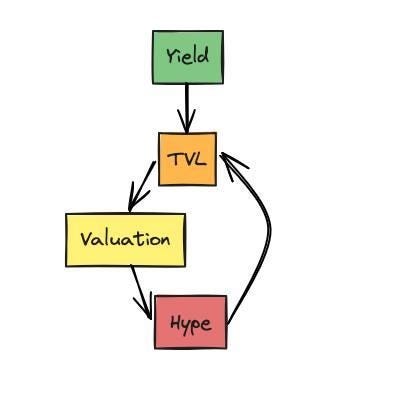
In this loop, locked capital creates the appearance of growth while masking structural fragility. Vault balances can climb even as very little capital supports the real costs of running or improving a network. Over time, this hollowness becomes visible in the form of liquidity crises, unsustainable emissions, and reflexive unwinds.
Why Another DeFi Renaissance
The question, then, is why stay constructive on DeFi at all? The answer is that several existential problems remain unresolved and continue to matter. These include:
Fragmented and highly mobile liquidity
Utility-light or utility-less protocol tokens
Commoditized yield that fails to differentiate risk
Overleverage and brittle collateral structures
These issues are not unique to DeFi, but DeFi experiences them more acutely and more visibly. They intersect directly with a growing distrust of centralized exchanges and increasingly sophisticated market manipulation, which reinforces a structural need for robust non-custodial financial infrastructure.
The thesis is simple: as long as capital seeks non-custodial rails, there will be demand for better-designed DeFi systems. The gap between that demand and today’s incentive design is where the next phase of innovation can occur.
Liquidity Providers => Liquidity ‘Nodes’
Across today’s infrastructure landscape, more than $6 billion are locked in nodes that secure various networks. In that model, node operators stake capital, invest in hardware, and maintain uptime in exchange for protocol rewards and modest transaction fees. The underlying bet is that token prices will appreciate enough for rewards to exceed operating costs and opportunity cost over the long term.
DeFi, by contrast, has grown out of a culture of commoditized yield. Many participants simply chase the highest advertised “risk-free” returns or rotate into more aggressive vaults promising double-digit yields. To less sophisticated capital, a higher percentage looks like a better outcome regardless of the underlying risk profile. This pattern creates mercenary liquidity that can depart quickly and exacerbate liquidation cascades, leaving protocols exposed when conditions shift.
A more sustainable design would prioritize “stickier” liquidity positions and reward longer-term alignment. One promising direction is to treat liquidity providers (LPs) more like infrastructure operators and to compensate them with protocol utility tokens in a transparent, rules-based way. In this model, LPs stake tokens and liquidity and meet clear quality criteria, similar to how node operators meet uptime and performance standards. Instead of emissions purely for TVL optics, rewards become tied to the health and resilience of the liquidity base.
Projects such as Flying Tulip push toward this direction by experimenting with redemption-based mechanisms. In that setup, rewarded tokens can be used to reclaim the original principal from a reserve, while selling rewarded tokens forfeits both redemption rights and yield. This approach reframes protocol tokens as risk-bearing claims with embedded downside protection rather than purely speculative assets, creating a more aligned incentive structure between LPs and protocol success.
The outcome is a more reflexive and healthier relationship between token price, liquidity, and network performance:
If token price strengthens and yields remain intact, participants benefit both from income and appreciation.
If token price weakens, yields act as a compensating factor and the system defaults toward a more traditional yield profile rather than collapse.
In this framing, some capital used to acquire and lock protocol tokens will never reappear as raw TVL metrics, but what emerges is more valuable: a committed LP base with clear alignment to long-term network viability.
DePIN As A Practical North Star
Web3’s settlement layers have demonstrated that networks of independent, incentivized participants can maintain shared state reliably over time. That same principle extends beyond ledger maintenance to a broad spectrum of digital infrastructure services. The most compelling argument for decentralization is not only ideological; it is operational. In many cases, a distributed network of providers can deliver better price, resilience, and coverage than a small group of centralized intermediaries.
Today’s digital infrastructure stack is heavily intermediated. Households and enterprises depend on a small set of oligopolistic providers for connectivity, storage, compute, and content delivery. That structure reinforces price-taking behavior and leaves customers with limited choice. Initiatives like DAWN seek to invert this model by turning unused residential bandwidth into a local marketplace governed by on-chain proofs of location and quality of service. The goal is to reintroduce competition at the household level and chip away at structural markups.
At the same time, immersive experiences and spatial computing are pushing infrastructure demands far beyond what legacy 2D-optimized systems were designed for Mawari addresses this gap with an Immersive Compute Network that distributes real-time 3D rendering and AI inference across a global network of community-operated GPU nodes, streaming high-quality XR content closer to end users while significantly reducing bandwidth requirements. The project has already powered tens of thousands of hours of live XR streaming and now uses a DePIN model to scale capacity in line with demand.
Reliance on centralized providers also introduces systemic fragility. A major AWS outage in October 2025 was estimated to cost roughly tens of millions of dollars per hour at peak, with total losses clustering around the hundreds of millions and broader ripple effects running into the billions as dependent services went offline. Telecom and network failures more broadly are estimated to cost around 160 billion dollars annually worldwide, underscoring how much value now rides on a small number of core infrastructure providers. A recent Cloudflare incident, which briefly disrupted a significant share of global web traffic including platforms such as X and ChatGPT, highlighted how issues at a single edge network can impose multi-billion-dollar-per-hour downtime costs on affected businesses and applications.
Decentralized wireless projects such as Quantinium attempt to reduce that single-point-of-failure risk by transforming everyday routers into Wi-Fi, 5G, and IoT access points that form a user-owned mesh network. The result is a topology that can degrade gracefully rather than catastrophically when individual nodes drop offline.
The longer-term vision is straightforward: a world where neighbors are both consumers and providers of digital infrastructure. As more homes and devices come online, capacity scales roughly in line with demand. Projects like DAWN, Mawari, and Quantinium point in the same direction: infrastructure networks that grow organically with participation, with the closest service provider often just next door rather than in a distant data center.
Rethinking DePIN Token Design
Tokens in DePIN systems should exist to coordinate expansion and upgrades, not to mimic the economics of settlement-layer blockchains. In traditional layer-1 networks, token price, staking, and hardware investment often maintain a relatively tight relationship with network security and value stored. Transplanting that model directly into DePIN can be counterproductive. If billions of dollars flow into tokens and nodes that do not deliver in-demand services, the economic foundation erodes and token price should rationally follow.
This is where conditional or milestone-based token emissions enter. Instead of emitting tokens continuously based on current utilization, a DePIN network can choose to:
Launch in one or a few high-priority metropolitan areas.
Release new token emissions only as specific geographic or infrastructure milestones are reached.
Require each new node in a target market to acquire and stake tokens, partially offsetting emissions.
The design goals of this approach include:
Making network growth legible through a clear sequence of expansion events.
Constraining inflation so that new supply aligns with credible upcoming demand.
Creating discrete informational milestones that the market can evaluate and price in.
This stands in contrast to “usage-based inflation” models where tokens are minted as a function of current bandwidth utilization or request volume. While these models aim for smoothness and predictability, they often produce unintended consequences:
Token holders lack clarity about maximum supply over any given time horizon.
Token price does not move in tight lockstep with incremental usage, because markets price expectations and narratives rather than only current fees.
Increasing supply when demand is flat or drifting lower weakens the economic foundation instead of reinforcing it.
Emissions tied to clear, memorable milestones provide a more human-readable roadmap for value accrual. Each new phase of network growth becomes an event around which attention, participation, and capital can coordinate. In that environment, dilution is acknowledged as inevitable, but the focus shifts to maximizing demand at the moments when new supply enters the system.
Ultimately, the key question is not whether tokens are necessary but how they are used. Token design that keeps the informational and psychological dimension of markets front and center is more likely to succeed than designs that assume raw usage metrics alone will carry the narrative.
Where Focus Goes In 2026
The objective is not to predict every twist in the broader crypto market. The focus is on domains where persistent, real-world problems still lack robust solutions. DeFi and DePIN sit at that intersection. Both wrestle with incentive structures that are misaligned with long-term value creation, yet both exhibit durable user demand and clear paths for architectural improvement.
Across both sectors, token design remains a primary leverage point. Well-calibrated mechanisms can attract aligned participants, distribute risk intelligently, and make systems more resilient to shocks. Poorly calibrated ones can accelerate boom-bust dynamics and concentrate fragility.
The direction for 2026 is clear: identify the most important pressure points, design around them thoughtfully, and treat tokens as coordination tools rather than purely as momentum instruments. Those are the areas where Republic is concentrating effort and where the next wave of meaningful progress is most likely to come from.
If you enjoyed this read and want to stay updated on future insights, follow us on X, Substack and LinkedIn.
About Republic
Republic accelerates the growth of Web3 by supporting the industry’s most ambitious projects and investors. With a world-class team of strategists, the Republic Research arm guides projects from seed to liquidity, offering expertise in tokenomics, smart contract development, fundraising, and marketing. Its platform also includes global token offerings, institutional crypto funds, and enterprise-grade solutions for Web3 startups. Republic Research has played a key role in the success of projects such as Avalanche and Supra, among others. As part of the Republic ecosystem, which has deployed over $2.6 billion across 150 countries, Republic Research is a leader driving innovation in the Web3 space.
Republic Research collaborates with the most promising Web3 projects to drive growth, innovation, and establish a leadership position in the industry. If you’re ready to take your venture to the next level, reach out to us today!
Disclosures
The content of this article is for informational purposes only and should not be considered financial, investment, or legal advice. Republic Crypto LLC d/b/a Republic Advisory Services is a subsidiary within a family of companies owned by OpenDeal Inc. (together sometimes referred to as “Republic”) located at 149 5th Avenue, New York, New York 10005. The author is not an Associated Person or Registered Representative of OpenDeal Portal LLC or OpenDeal Broker LLC, nor is author an Access Person of Republic Capital Advisor LLC and Republic Capital GP LLC, nor of Republic Master SPC, LTD and its feeders Republic Funds (BVI), SPC, LTD and R/Crypto Fund I, LP feeder funds (collectively, the “ Crypto Fund”). Investing in cryptocurrency projects involves a high degree of risk, including the potential loss of all invested funds. The views expressed are those of the author and do not necessarily reflect the opinions of Republic. Readers should perform their own due diligence and consult with a qualified financial advisor before making any investment decisions. Past performance is not indicative of future results. Cryptocurrency markets are highly volatile, and regulatory environments are subject to change. Always invest responsibly.
 | A guest post by
|